


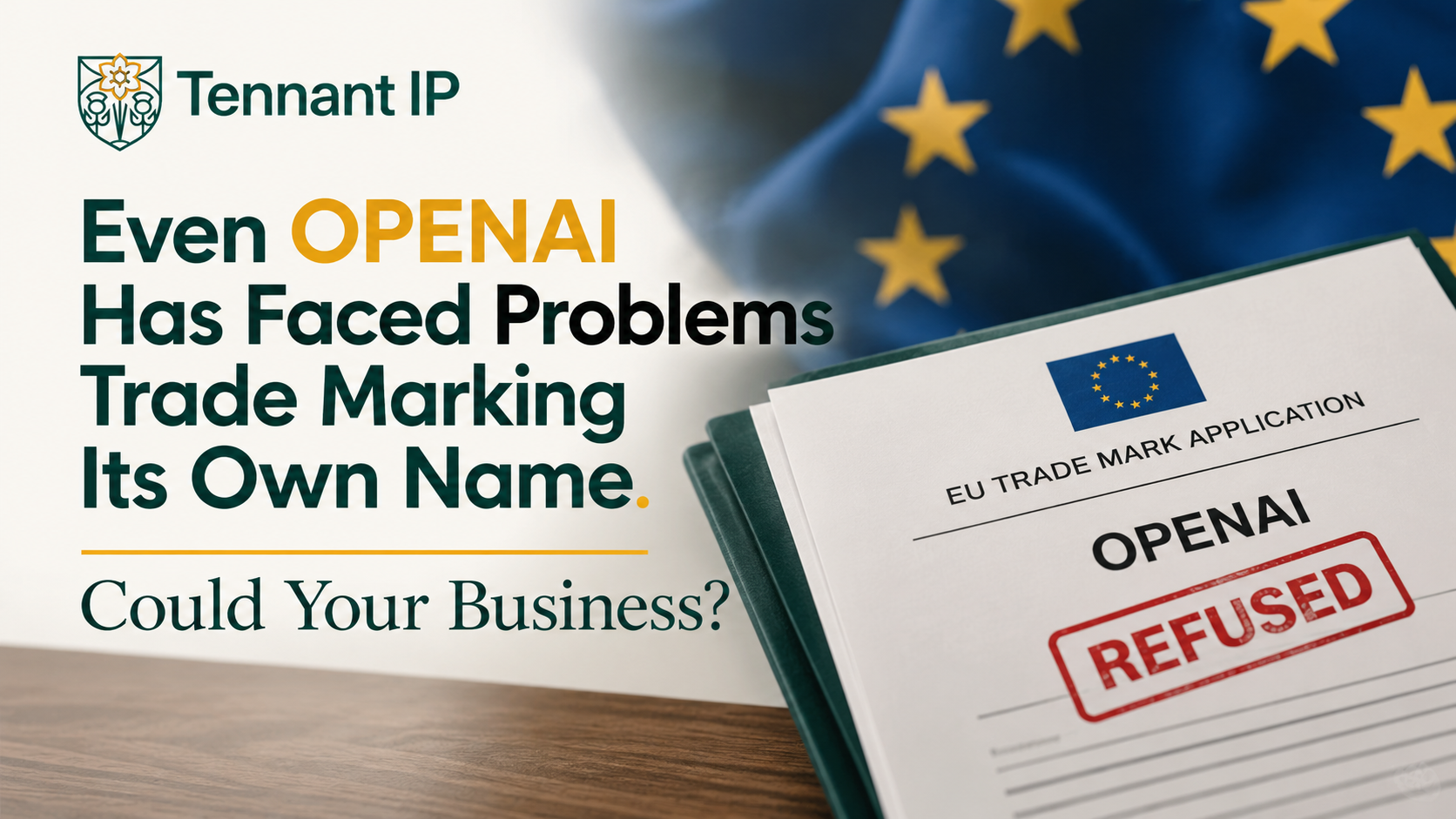
What a European court ruling teaches businesses about choosing and protecting their brand.

You might think the company behind ChatGPT would have little difficulty protecting its own name.
However, a recent OpenAI trade mark decision shows that even globally recognised businesses can encounter problems registering their brands.
On 15 July 2026, the EU General Court dismissed OpenAI's challenge to a decision refusing registration of the OPENAI name as an EU trade mark for certain goods and services.
The reason? The name was considered descriptive and lacking the distinctive character required for registration.
It's a surprising outcome, particularly when you consider just how familiar the name has become.
But the case highlights something every business owner should understand.
A name can be commercially successful, widely recognised and valuable to a business without automatically qualifying for trade mark registration.
And that's important whether you're starting a business, launching a product, introducing a new service or planning to expand into overseas markets.
Why was the OpenAI trade mark refused in the EU?
The story began on 15 June 2023, when OpenAI applied to register OPENAI as a European Union trade mark.
The application covered a range of goods and services, including those relating to computer software, artificial intelligence and technology.
However, the European Union Intellectual Property Office (EUIPO) objected to the name.
The issue wasn't whether OpenAI was a legitimate business or whether it could continue trading under its name.
The question was whether OPENAI met the legal requirements for registration as a trade mark for the particular goods and services covered by the application.
The EUIPO considered the name descriptive and lacking inherent distinctive character.
OpenAI challenged that assessment, but the EUIPO Board of Appeal upheld the refusal.
The company subsequently took the matter to the EU General Court.
On 15 July 2026, the Court dismissed OpenAI's action, leaving the contested refusal in place.
You can read the official EU General Court judgment, Case T-555/25.
The decision provides an interesting example of how trade mark law can produce an outcome that might seem surprising from a commercial perspective.
Why was OPENAI considered descriptive?
At the heart of the OpenAI trade mark case was the meaning of the name itself.
The EUIPO and the Court considered the two elements that make up OPENAI:
- OPEN – which can suggest something accessible, available or unrestricted.
- AI – the widely recognised abbreviation for artificial intelligence.
When combined, the elements could be understood as describing characteristics of the relevant AI-related goods and services.
From a marketing perspective, the name makes sense.
It's short, memorable and immediately provides an indication of the technology involved.
But from a trade mark perspective, that can create difficulties.
A trade mark is intended to distinguish the goods or services of one business from those of another.
If a name primarily describes what a business provides, or an important characteristic of it, obtaining exclusive registered rights can become more difficult.
Trade mark law is designed, in part, to prevent businesses from monopolising terminology that competitors may legitimately need to describe their own products or services.
That's not something unique to artificial intelligence.
The same principle can apply to businesses operating in almost any industry.
But surely everybody knows who OpenAI is?
That's probably the first question many people will ask.
OpenAI has become one of the best-known names in technology. Its association with ChatGPT has brought the company enormous international recognition.
Surely that must count for something?
It certainly can.
However, there's an important legal distinction between a name being inherently distinctive and one that has acquired distinctive character through use.
An inherently distinctive name is capable of identifying the commercial origin of particular goods or services because of the nature of the name itself.
A descriptive name may, in certain circumstances, become registrable if sufficient evidence demonstrates that consumers recognise it as identifying one particular business.
This is known as acquired distinctive character.
Establishing this can require evidence of how the name has been used, its recognition among relevant consumers, advertising, market presence and other factors.
Commercial success and public familiarity can therefore be relevant, but they don't automatically answer the legal question.
Importantly, the General Court's judgment concerned the assessment of OPENAI's inherent registrability. OpenAI's separate claim concerning acquired distinctive character through use was not determined in that judgment.
That distinction matters.
The decision does not mean OpenAI can never obtain trade mark protection for its name.
What does the OpenAI trade mark ruling mean for businesses?
Although the case involves artificial intelligence, the underlying lesson applies much more widely.
When choosing a business name, the natural instinct is often to make it immediately understandable.
A business might want its name to explain:
- What products or services it offers.
- Where it operates.
- Who its customers are.
- What benefits it provides.
- What technology or methods it uses.
There's nothing inherently wrong with that approach.
Indeed, from a marketing perspective, descriptive names can have obvious advantages.
Customers may understand exactly what a business does without needing much explanation.
But there's a potential downside.
The more directly a name describes the goods or services, the harder it may be to obtain meaningful exclusive trade mark protection.
And that can become increasingly important as the business grows.
Imagine investing years developing a successful company, establishing a reputation and building customer loyalty, only to discover that the name you've chosen is difficult to protect against competitors.
It's a situation most business owners would rather avoid.
Combining two familiar words doesn't always create a distinctive trade mark
Another interesting aspect of the OpenAI decision is the treatment of names formed by combining existing words or expressions.
Businesses frequently develop names by joining words, shortening phrases or adapting familiar terminology.
Sometimes that produces a distinctive name capable of protection.
Sometimes it doesn't.
What matters is how the combined expression is understood in relation to the goods or services being offered.
Simply removing the space between two descriptive words doesn't automatically turn them into a distinctive trade mark.
Nor does creating a new combination necessarily overcome an objection that the resulting expression is descriptive.
The important question remains whether the name identifies the commercial origin of your goods or services, rather than simply describing them.
It's something worth considering before deciding that a proposed name is sufficiently unusual to be protectable.
Does a UK trade mark provide protection in Europe?
There was another important point in the OpenAI proceedings.
OpenAI referred to trade mark registrations for its name in numerous other countries, including the UK.
However, the existence of registrations elsewhere did not determine whether the name qualified for registration under EU trade mark law.
Trade mark rights are territorial.
Different jurisdictions operate under their own legal frameworks, and applications must satisfy the requirements of the relevant trade mark system.
For UK businesses, this is particularly important.
A UK trade mark registration doesn't automatically provide protection throughout the European Union.
Likewise, a name accepted for registration in the UK may encounter objections in other countries.
If you're planning to expand internationally, it's important to consider where protection will be needed and whether your proposed name is likely to meet the relevant requirements.
This may involve international trade mark searches and advice on the most appropriate registration strategy.
For businesses with overseas ambitions, Tennant IP's trade mark services can help identify appropriate options for protecting a brand beyond the UK.
A good business name isn't necessarily a strong trade mark
For me, this is the main lesson businesses should take from the OpenAI case.
When people choose a name for a new business, product or service, they naturally concentrate on commercial considerations.
Does it sound good?
Is it memorable?
Will customers understand it?
Is the domain name available?
Will it work on social media?
Will it look good on the website, packaging or signage?
All perfectly reasonable questions.
But as a Chartered Trade Mark Attorney, I'd encourage businesses to ask a few more.
Is the name distinctive?
Does it describe what the business sells?
Could competitors reasonably need to use the same terminology?
Are there existing registered trade marks that might cause a conflict?
And, importantly, how much meaningful protection are we likely to obtain?
A good brand needs to work commercially.
But ideally, it should also be capable of being protected.
Think about trade mark protection before committing to a name
One situation we regularly encounter is a business seeking trade mark advice after it has already invested considerable time and money in a new name.
The directors have agreed on it.
The domain name has been purchased.
The logo has been designed.
The website is being developed.
Social media accounts have been created.
Perhaps signage, packaging or marketing materials have already been ordered.
Then somebody asks:
"Can we trade mark it?"
Sometimes the answer is straightforward.
But sometimes an earlier registration creates a problem.
Or the proposed name may be too descriptive to obtain the level of protection the business expects.
In some circumstances, it may be possible to register the name with relatively narrow protection. In others, a different name might be the better commercial option.
By that stage, changing direction can become expensive.
That's why I'd always recommend considering trade mark protection before committing substantial resources to a new brand.
A pre-registration trade mark search can help identify conflicting earlier rights and potential risks before a business becomes too attached to a particular name.
It is also important to consider whether the name is sufficiently distinctive, alongside checking for conflicting earlier rights.
Finding a problem at the beginning gives you options.
Finding it after launch can leave you with considerably fewer.
Five questions to ask before choosing a business name
If you're launching a business, developing a product or planning a rebrand, I'd recommend asking these five questions early in the process.
1. Is the name distinctive?
Does it genuinely identify your business, or does it mainly describe the goods or services you're offering?
2. Is somebody else already using or registering something similar?
An existing trade mark could prevent you from registering your chosen name or create problems when you begin using it.
3. Could competitors reasonably need to use the same words?
If the name consists of descriptive terminology, obtaining exclusive rights may be difficult.
4. Where will your business operate?
A name that works in the UK might encounter problems elsewhere. If international expansion is part of your plans, consider those markets early.
5. Have you taken trade mark advice before investing in the brand?
Professional advice can help identify potential conflicts and assess whether a proposed name offers a realistic opportunity for meaningful protection.
None of these questions should be considered in isolation.
The aim is to choose a commercially effective name while giving the business the best possible opportunity to establish valuable trade mark rights.
Does the ruling mean OpenAI cannot use its name?
No.
And that's an important point to clarify.
The ruling concerned the registrability of the OPENAI word mark for particular goods and services within the European Union.
It did not amount to a general prohibition on the company using its name.
Nor did it invalidate all OpenAI's existing trade mark rights.
Furthermore, the judgment did not finally determine whether the name could qualify for registration on the basis of distinctive character acquired through use.
What the case demonstrates is that even internationally recognised businesses must satisfy the relevant legal requirements when seeking trade mark registration.
Being famous doesn't automatically remove those requirements.
What can businesses learn from the OpenAI trade mark decision?
You don't have to be a global technology company to encounter the issues highlighted by this case.
Businesses of every size invest time, money and effort into establishing their names, products and reputations.
As a business grows, its brand can become one of its most valuable assets.
But that value deserves appropriate protection.
Choosing a name that works commercially is important.
Understanding whether it can be protected is just as important.
And the earlier you consider both, the better position you're likely to be in.
Thinking about a new business name or protecting an existing brand?
Whether you're launching a company, developing a product, introducing a new service or planning a rebrand, it makes sense to consider trade mark protection from the outset.
At Tennant IP, we help businesses assess proposed names, carry out trade mark clearance searches, identify potential conflicts and develop appropriate UK and international protection strategies.
We can also advise on the registrability of proposed trade marks and the potential difficulties that descriptive names may present.
If you're considering a new name, or you're unsure how well your existing brand is protected, we'd be happy to discuss your options.
Contact Tennant IP to speak with Mike Tennant about protecting your brand.
Frequently Asked Questions
Why was OpenAI refused an EU trade mark?
The EUIPO considered the OPENAI name descriptive and lacking inherent distinctive character for certain goods and services. On 15 July 2026, the EU General Court dismissed OpenAI's challenge to that decision. The judgment did not resolve the separate question of whether the name had acquired distinctive character through use.
Does the ruling mean OpenAI cannot use its company name?
No. The judgment concerned a particular EU trade mark application. It did not prohibit OpenAI from using its name or cancel all its existing trade mark rights.
Can you register a descriptive business name as a trade mark?
Descriptive names can face objections because they may lack the distinctive character required for registration. However, some may become registrable if sufficient evidence demonstrates that they have acquired distinctive character through use.
Can I trade mark my business name?
Potentially, yes. A business name may qualify for trade mark registration if it satisfies the relevant legal requirements and does not conflict with earlier rights. Registering a company name at Companies House does not automatically provide equivalent trade mark protection.
Does a UK trade mark protect my business in Europe?
A UK trade mark does not automatically provide protection throughout the European Union. Businesses trading or planning to trade in EU countries should consider whether additional registrations are necessary.
What is a trade mark clearance search?
A trade mark clearance search examines existing registered and pending trade marks to identify potential conflicts with a proposed name. Depending on the search, it may also consider other relevant rights. It can help businesses understand the risks before investing in a new brand.
When should I register a trade mark?
Ideally, you should consider trade mark protection while developing your brand and before investing heavily in its launch. Early advice can help identify problems and inform the timing of an application.
About the author
Mike Tennant is a Chartered Trade Mark Attorney and Director of Tennant IP, based in Newport, South Wales.
Mike advises businesses on UK and international trade mark clearance, registration, disputes and brand protection, helping organisations of all sizes understand, protect and manage their valuable intellectual property.
Legal source: Judgment of the EU General Court, OpenAI, Inc. v EUIPO, Case T-555/25, 15 July 2026.

